
Epigraph
History will be kind to me, for I intend to write it. (Winston Churchill)
But you know what? History will not be kind to Yalta. Because the people who got betrayed? They never stopped writing.
Author: Ben Xu
It was the best of Treaties. It was the worst of Treaties. It was calm, and it was chaos. Unity, and division. Strength, and fear. Survival, and annihilation.
Preface: The Unbalanced Logic of Power
In human power structures, there is a logic that keeps showing up. It is predatory. Take from the bottom. Give to the top. The poor get poorer. The rich get richer. We call this the Matthew Effect. And it is everywhere. This imbalance is the heartbeat of history. Dynasties rise and fall, and the pattern is always the same.
Think of it like a game of Monopoly with a hidden rule. The player who goes first gets an extra five hundred dollars and the right to buy properties before anyone else rolls the dice. This is the Dealer advantage. In a fair game, the first player should rotate counterclockwise. But the guy who went first wants to stay first forever. He builds hotels, charges rent, and drains everyone else. The other three players realize they are being systematically drained and form an alliance. They stop trading with the Dealer until eventually, they flip the table. This is the Dynastic Cycle. The Dealer tries to stay Dealer forever, the others unite to overthrow him, the game resets, and a new shuffle begins. This is the Tale of Two Treaties.
Prologue: The Thermodynamics of Civilization
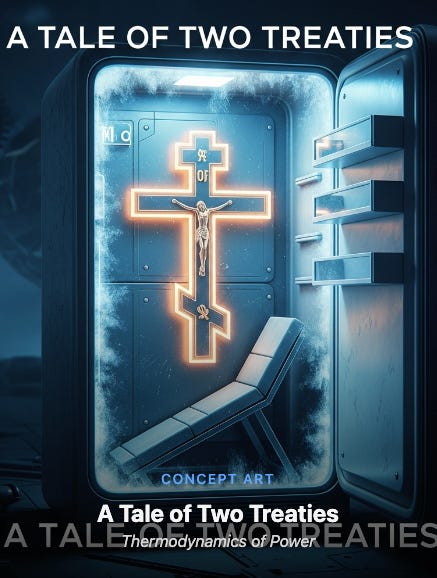
Every social system humanity has ever built is solving the same problem: Where does the heat go? Think of your refrigerator and your air conditioner. Both cool things down, but they work totally differently. A refrigerator is a closed system. It sucks heat out of the box and dumps it into your kitchen. The colder the inside gets, the hotter the kitchen becomes. If you seal the kitchen, the whole thing eventually overheats and burns out. It just moves the chaos around.
An air conditioner is different. It has an outdoor unit. It takes the heat from your living room and dumps it outside. Your comfort indoors is bought and paid for by the roar of the machine outside. The neighborhood heats up, but you are fine.
Section 1: The Entropy Trap and the Refrigerator Dilemma
When Rome expanded, it was like an air conditioner. Pushing borders outward was venting the pressure. But when Hadrian built his wall, the empire became a refrigerator. With no more outdoor unit, it started eating itself until it burned out. For the last five hundred years, capitalism has been searching for outdoor unit slots—colonies where chaos and poverty can be exported to maintain civilization at home.
When the heat builds up, some people try to pull the plug. The Waldensians, Thoreau, and Robert Owen were not just dreamers; they were sensors. They felt the Refrigerator Dilemma. When society can no longer expand, the property system turns into a meat grinder. Their utopian socialism was a stress response, a panic born from the peak of internal friction.
Section 2: The Great Divide
Britain had the Royal Navy as its outdoor unit, allowing it to write the winner’s manual: Economics. Germany, landlocked and fragmented, was a refrigerator. Its pressure fermented into philosophy—the painkiller for those who are trapped. Britain’s secret weapon was the Patent Act of 1624, a land law for ideas that made innovation profitable. Germany unified too late, excelling in closed-system efficiency like the internal combustion engine but carrying the curse of having coal but no oil. The 3B Railway was their attempt at a land-based outdoor unit, but it was destroyed in Sarajevo.
Section 4: The Bohemian Rhapsody and the Irish Trap
Gavrilo Princip’s shots in 1914 killed the reformer Archduke Ferdinand, who was offering the Slavs a “mercy win” of autonomy. This was the Irish Home Rule Trap. Just as British radicals realized that reform is the enemy of revolution, Princip knew that a comfortable cage is more dangerous than visible chains. He didn’t want a seat at the table; he wanted to burn the table down.
Section 5: The Royal Bloodline and Precedent
World War One ended with massive reparations because the monarchs were cousins—the R1b bloodline. A King does not execute a King. By blaming the nation instead of the Kaiser, they created the legal precedent that protected the Japanese Emperor thirty years later. This accountability gap turned Germany into a pressure cooker, leading the people to vote for Hitler—the ultimate compressor.
Section 6: The Stockholm Syndrome of the State
Scandinavia’s social democracy worked only because of hard assets (iron, timber, oil) and a small, oarsman-like population. In software terms, this is Linux—decentralized and open source. But it created a dark side: the Stockholm Syndrome of the State, where citizens fall in love with the captor that manages their souls. Greta Thunberg’s scream is the response of a child who has never felt the cold, yelling at the sun because the air conditioner is a machine that will eventually break.
Section 7: Time Sovereignty
The October Revolution happened in November because Russia refused to surrender the “Old Time of God” (the Julian Calendar) to the heretical West. To the Orthodox heart, every day must be recorded in the Book of Life. Lenin used the Soviet Wrench to pull the plug on God’s time, but the civilizational jetlag remained.
Section 8: Cathedral versus Bazaar
The East chose the Cathedral (Unix)—ancient, rigid, and proprietary. The West chose the Bazaar (Linux)—open and decentralized. Peter the Great naming his city Saint Petersburg was a theological heist, an attempt to install Eastern “Windows” into Western hardware to claim the keys of sovereignty.
Section 9: The Matryoshka Arbitrage
Russia’s structure is a Matryoshka of extraction. From Moscow to the satellites, each layer is a valve for Institutional Arbitrage. Built on the lie of “undifferentiated labor,” Moscow extracted grain and minerals in exchange for overpriced tractors. It was not trade; it was looting with equations.
Section 10: The Cyber God and the Soviet Enclosure Movement
To run a command economy, you need a Cyber God. In the 1960s, Soviet scientists built the Setun ternary computer. But the bureaucracy killed it because a perfect machine makes officials redundant. This was the Soviet Enclosure Movement—just as “sheep eat men,” the Cyber God would have eaten the bureaucrats. The system chose controlled incompetence to keep the desks full.
Final Section: Maxwell’s Demon and the Ghost of the Machine
For five hundred years, the West has played Maxwell’s Demon, using rules and trade to funnel “hot” molecules of wealth to the right and “cold” molecules of poverty to the left. Communism was the specter that refused to be sorted, wanting to smash the partition. NATO used external energy from colonies to power its demon; the Warsaw Pact had none and consumed itself. Today, the dream of the Cyber God has migrated to Silicon Valley. The question remains: Can any system achieve efficiency without making its own citizens obsolete?
To explore the deeper patterns of this transformation and the logic of our survival, search for The Kun Peng Chronicles Volume 1 (鲲鹏志·I) on Kindle. The story is far from over.
End.


