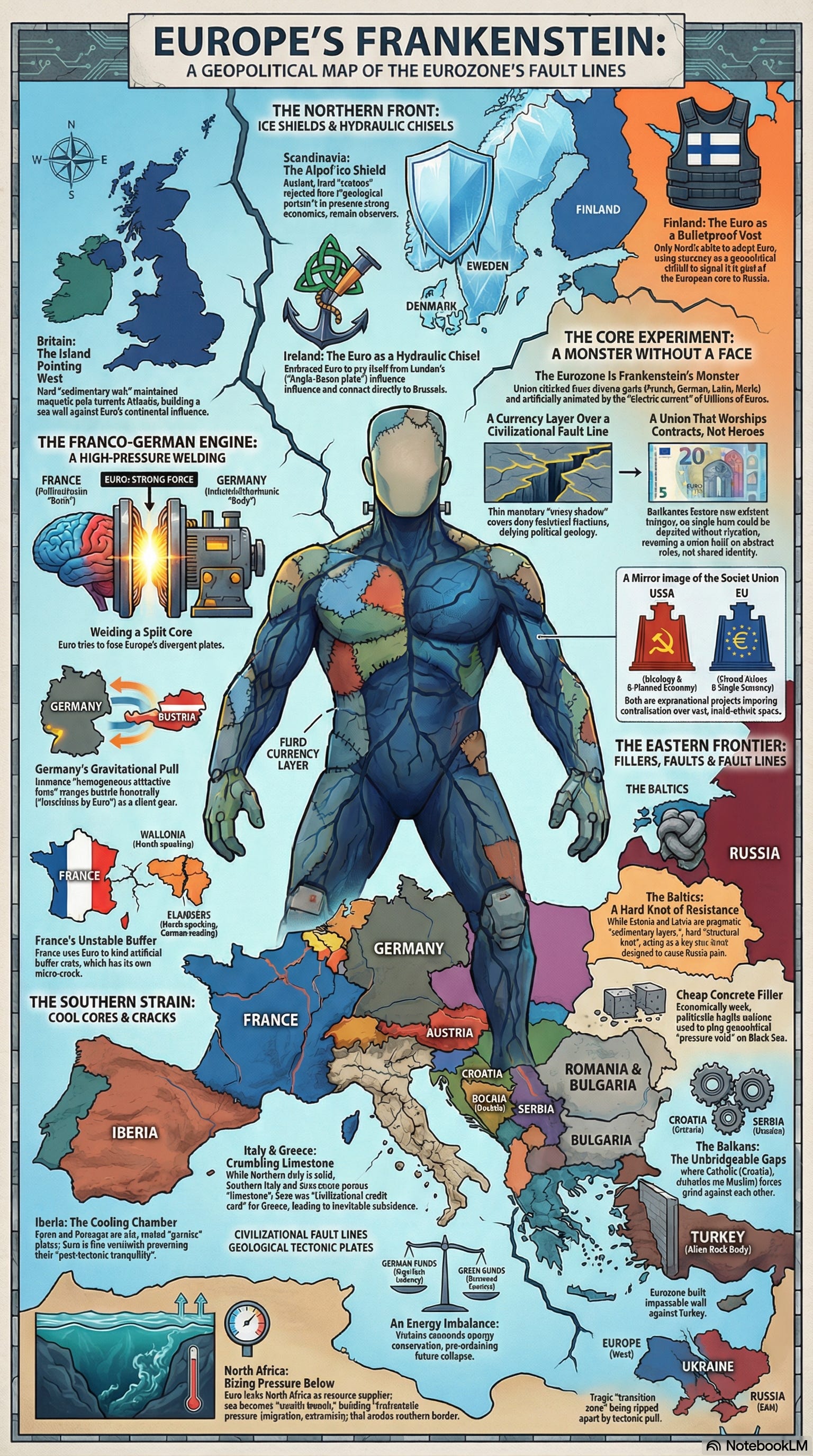
Translated from “A Tale of Two Treaties”, Chapter 8, Section 5.
Time: January 1, 2002
Location: Eurotower, Frankfurt am Main
Subject: The Great Suture
When the New Year’s bells rang out before the giant Euro sculpture in Frankfurt, the air was thick with a fervor bordering on religious hysteria. The European elite—men in bespoke suits speaking a polyphony of tongues—were, at that moment, playing the role of Mary Shelley’s Victor Frankenstein.
Before them on the operating table lay a colossal body: cobbled together from Frankish bones, Germanic muscle, Latin veins, and Slavic skin. A body that had been dismembered in the trenches of Verdun and charred on the beaches of Normandy.
And then, the bankers pulled the switch.
A current of trillions of volts—the Euro—surged through the complex financial wiring, forcibly injected into every cell of this monstrosity. The roar of the printing presses was not just the sound of money; it was the sizzle of necrosis being galvanized into life. They believed they were printing tickets to prosperity. But viewed through the cold lens of Rock Mechanics, they were attempting an engineering feat that defied geological laws: they were trying to use a thin currency layer as a “Stress Shadow” to paper over a civilization fracture zone that ran miles deep.
They were attempting to cheat gravity, cheat time, and cheat history.
I. The Cooling Chamber: The Afterglow of Faded Empires
(Tectonic Unit: The Spanish Block + The Portuguese Block)
Let us first turn our gaze to the southwest, south of the Pyrenees. In Frankenstein’s lab, this is the corner that worries him the least.
Here, there is no screeching of geological stress, only the sigh of history. Spain and Portugal, these two ancient blocks of granite, are remarkably consistent in lithology. Both were once arrogant oceanic plates, extending their tentacles to the Americas and the Far East, and both exhausted their geothermal core heat centuries ago.
There is no contradiction between them, for all their ambition and hatred were consumed by the waves of the Atlantic centuries ago when the Treaty of Tordesillas divided the globe. Today, they are two fully cooled, solidified rocks.
The arrival of the Euro was not a strong glue for them, but a layer of exquisite varnish. It did not change the structure of the rock; it merely preserved their last dignity as “former empires.” People in Madrid and Lisbon lie lazily under the southern European sun, settling accounts for ham and wine in the same currency. This is a “Post-tectonic Tranquility.” In this vast geological museum, they are content to be two shiny exhibits, no longer participating in the crushing of plates.
II. The Celtic Counter-Strike: The Cleaved Archipelago
(Tectonic Unit: Anglo-Saxon Plate vs. Celtic Plate)
To the north, across the English Channel, the geological map instantly becomes grim. A violent “Deep Stratum Delamination” is taking place.
Although the British Isles look like a whole on the map, in terms of rock mechanics, they belong to two mutually exclusive strata.
On one side is Anglo-Saxon Britain, a sedimentary layer that is hard, cold, and full of arrogance. Although geographically close to Europe, its magnetic pole always points across the Atlantic. It defends the Pound Sterling like a breakwater, refusing the erosion of any continental warm current.
On the other side is Celtic Ireland. For centuries, it has been crushed under the giant rock of Britain (colonialism and famine). For Ireland, the Euro in 2002 was not just a currency; it was a “High-Pressure Hydraulic Chisel” handed over by geologists.
The Irish took this chisel without hesitation and drove it into the gap between themselves and Britain. They injected the energy of the Euro, using this external force to pry open the wound named “Northern Ireland.” They no longer needed London’s charity; through the umbilical cord of the Euro, they connected directly to the matrix in Brussels. This is a “Phase Transition” in geopolitics—Ireland instantly transformed from a satellite island of Britain into an enclave of the European continent at sea.
III. Charlemagne’s Double-Headed Eagle: The Frankish Dual Core
(Tectonic Unit: West Frankish/French Block & East Frankish/German Block)
In the center of the laboratory, Frankenstein is performing the highest-risk “High-Voltage Welding.”
This is the parent rock of Frankish civilization. A thousand years ago, the legacy of Charlemagne underwent a violent “Lattice Splitting” here, cleaving into France (Political Brain/Latinized) in the west and Germany (Industrial Body/Germanic) in the east. The Euro is the “Strong Interaction Force” attempting to forcibly re-aggregate these two alienated atomic nuclei.
But this is not just an embrace of two giants; they each drag a “Shadow Satellite,” making the geological structure incredibly complex.
The French block is not intact. On its northeast corner clings a strange rock named Belgium. This is a man-made “cushion,” debris stuffed in by history to prevent the direct collision of Britain, France, and Germany. Geologists know that there is a huge “Micro-crack” inside Belgium—Flanders and Wallonia. The injection of the Euro seemingly covered the crack but intensified the stress. France attempts to use the Euro to solidify this crumbling cushion into its Latin gravitational sphere.
East of the Rhine, the German block displays a terrifying “Homogeneous Adsorption.”
Austria, once the crown jewel of the Holy Roman Empire, is isotopically identical to Germany in geological composition. Although the “State Treaty” forbids their physical merger, under the microscope of the Euro, the exchange between the Deutsche Mark and the Austrian Schilling vanished instantly. “Anschluss by Euro” was de facto completed financially. This “Germanic Binary Star” constitutes the hardest, coldest core of the Eurozone.
IV. The Northern Ice Shield: The Cold Observer
(Tectonic Unit: The Baltic Shield)
We zoom into the far north. Here, there is no noise, only the silence of extreme cold. This is Scandinavia, the geological “Baltic Shield,” the oldest and hardest “Craton” in Europe.
Denmark and Sweden, these two wealthy, cold, high-hardness rocks, showed extreme indifference to Frankfurt’s Frankenstein experiment. They have their own Crowns (Krona/Krone). They look at the southerners bleeding for exchange rates like they are watching fools. They rejected the Euro. Not out of poverty, but out of “Geological Hygiene.” They refused to let their high-quality assets dilute the bad debts of Southern Europe.
But within this ice shield, there is an exception—Finland. Why did only Finland throw away the Markka and embrace the Euro? Because of fear. Finland does not have the natural barrier of a strait like Sweden; it is pasted directly onto the belly of the Russian Bear. For Finland, the Euro is not currency; it is a “Bulletproof Vest.” It uses the Euro to send a silent signal to Moscow: “I am not just part of Northern Europe; I am an indivisible part of the European Core.”
V. The Bohemian Velvet: Elegant Laminar Sliding
(Tectonic Unit: Czech Block + Slovak Block)
Moving east to the heart of Central Europe, we see a textbook case of “Plastic Deformation.”
Unlike the brittle fractures of the Balkans that brought bloodshed, the Czechs and Slovaks staged a “Velvet” separation. Although these two rocks were once forcibly cemented together, their lattice structures never truly merged.
When the Soviet iron hoop rusted and broke, they did not choose to collide but chose “Laminar Sliding.” They calmly unbuttoned and went their separate ways. This separation was not for rupture, but for “weight reduction.” Like two climbers untying the rope between them so they could climb the mountain named “Western Civilization” faster, individually.
VI. The Baltic Stress Knot: The Lithuanian Iron Cross
(Tectonic Unit: Lithuanian Structural Knot vs. Estonian/Latvian Sediments)
Under the gray sky of the Baltic Sea, we must focus the microscope on the hardest bone—Lithuania.
Do not conflate the three Baltic states. Estonia and Latvia are geologically closer to the commercial sedimentary rocks of the “Hanseatic League.” They are pragmatic, Protestant, and Germanic.
But Lithuania is different. This is an outcrop of “Ancient Crystalline Rock.” Buried deep in its strata is the core of the “Polish-Lithuanian Commonwealth.” It is a fanatical fortress of Catholicism, the most stubborn “Structural Knot” on the Eastern European Plain. Sandwiched between the Russian enclave (Kaliningrad) and Russia’s ally (Belarus), it is not just the frontline; it is a steel needle stuck in Russia’s flank.
For Lithuania, the urge to join the West is not to sell milk, but for a “Holy War.” It acts as a “Stress Riser.” If this hard bone didn’t prop up the middle, the Baltic defense line would be a puddle of mud. It is a titanium alloy patch sewn by Frankenstein into the northeast corner.
VII. Twilight of the Gods: Roman Decay and the Byzantine Cliff
(Tectonic Unit: West Rome/Italy + East Rome/Greece vs. Anatolian Subduction Zone)
To the south, the lights on the operating table dim. This is the ancient sedimentary layer of civilization, smelling of decay and glory.
First is the forced binding of Italy and Greece. Geologically, these are two different types of rocks. The Lombardy plain in northern Italy is hard industrial rock, but the south and all of Greece are porous “Limestone Sediments.” The Greeks, with their Byzantine indolence, believe they are the emerald of European civilization and deserve to be provided for. For Greece, the Euro is not a currency but an unlimited “Civilizational Credit Card.” They used fake financial reports to cheat the security check in Frankfurt, leading to severe “Stratigraphic Subsidence.”
However, looking across the Aegean Sea, a visible “Geological Escarpment” lies there.
Turkey (Anatolian Plate), the heir to the Ottoman Empire, is frantically squeezing the edge of Europe. But the Euro has built an invisible “Immunity Wall” here. No matter how Turkey whitewashes its surface, European geologists see through its exogenous nature—Islamic, Turkic, neither Latin nor Germanic. Greece, holding a pile of overdue notes but armed with the Euro, stands at the edge of the cliff, mocking Turkey. The Euro draws the ultimate boundary of civilization here: on this side is “Holy Europe,” on that side are the “Barbarians.”
VIII. The Black Sea Masons: The Poor Joint Filler
(Tectonic Unit: Romanian Block + Bulgarian Block)
In the corner of Southeast Europe, Frankenstein looked at the leftover scraps and had to perform some rough “Grouting Engineering.”
Romania and Bulgaria. These are two rocks weathered and riddled with holes in the cold wind of the Cold War. The European Central Bank did not want them because their “gold content” was too low and their impurities too high.
However, from the perspective of geomechanics, the EU had to accept them. If these two stones were not filled in, a huge “Pressure Void” would form in the direction of the Black Sea. The Russian red mudslide could pour in along the Danube at any time. So, they were treated as cheap “Concrete Aggregate” and hastily stirred into the EU’s foundation.
IX. The Balkan Crusher: The Triaxial Shear Deadlock
(Tectonic Unit: Serbia Core vs. Bosnia Fracture vs. Croatia Edge)
This is the Bomb Site B of Europe. Frankenstein holds the pliers, unsure whether to cut the red wire or the blue one.
The Balkans is not a plate; it is a “Triaxial Shear Test” running at full speed. Catholic Croatia squeezes west; Orthodox Serbia pulls east; Islamic Bosnia is rubbed repeatedly in the middle.
The Euro becomes a ghost here. The Bosnians pegged their currency (Convertible Mark) to the Deutsche Mark (later the Euro) to survive, trying to find a bit of external anchoring force. But the Serbian iron core refuses to be melted. Even if Milosevic has been sent to The Hague, the Serbian block maintains amazing “Residual Stress” deep down. Any external monetary cement injected into this area will be instantly ground into powder by ingrained religious hatred and blood debts.
X. The Mediterranean Moat: Hydrostatic Pressure from Africa
(Tectonic Unit: Maghreb Accretionary Wedge)
Frankenstein built a thickened “Retaining Wall” on the southern edge.
Across the Mediterranean, the Maghreb region of North Africa does not belong to the European continent, but geomechanically, it is the leading edge of the African plate subducting northward. Huge “Hydrostatic Pressure” accumulates here—population explosion, poverty, and migration.
For North Africa, the Euro is the “Iterative Upgrade” of the old colonial system. Frankenstein uses the Euro to lock North Africa as a “Cheap Resource Supply Layer” and a “Low-end Product Dumping Ground.” The Euro has instantly widened the Mediterranean. The moat blocks the boats on the surface, but it cannot block the rising osmotic pressure (illegal immigration and infiltration) beneath the surface.
XI. The Great Eastern Abyss: The Uncrossable Moho
(Tectonic Unit: Russian Plate vs. Ukrainian Transition Zone)
Finally, Frankenstein stood on the banks of the Dnieper River, looking at the endless snowfields in the east. The scalpel stopped here.
This is the “Moho Discontinuity”—the boundary between the crust and the mantle, where properties change drastically. The light of the Euro cannot reach the domed churches of Kiev, nor the Red Square of Moscow. Western financial geology fails completely here.
Ukraine, this tragic “Transition Zone,” is being ruthlessly torn by two huge plates—the Europa Plate to the west and the Russian Plate to the east. This is a process of “Stretching and Thinning.” The printing presses in Frankfurt can print trillions of Euros, but they cannot print the filler to fill this abyss.
Epilogue: Frankistan vs. Turkistan
Before we close this geological report, let us take one last look at this monster named “Eurozone.” Even if we mock it, we must admit that it contains a terrifying, grand historical symmetry.
If we strip away the cloak of ideology, you will find that Brussels (EU) is the mirror image of Moscow (USSR). Both attempt to establish a “Centralized Operating System” over nation-states in a vast space full of ethnic contradictions.
The Soviet system: Ideology + Planned Economy + Idealism.
The EU system: Royal Kinship + Universal Values + Single Currency.
This ambition of “Depersonalization” is most intuitively printed on the banknotes.
Open a Soviet Ruble, and you see Lenin’s sharp eyes. That is the “Personified God.”
Open a US Dollar, and you see Washington. That is the “Founding Father.”
But open a Euro, and what do you see?
No faces. No Napoleon, no Bismarck, no Da Vinci.
Instead, you see “Bridges that do not exist” and “Empty Windows.”
This is the ultimate metaphor: The Eurozone is a supranational confederation without a “Father of the Nation.” It worships no heroes, only Contracts.
The Final Divide: Under the Lex vs. Under the Adat
Frankistan (The Eurozone):
Operating System: Under the Lex (Written Law).
Structure: Atomized. The human is a particle, a taxpayer ID.
Faith: Rational Logos. It attempts to bridge blood feuds with abstract reason.
Turkistan (Central Asia):
Operating System: Under the Adat (Customary Law).
Structure: Molecular. The Clan is the atom.
Faith: Blood and Revenge. When Lex blocks Adat, the law is trampled.
Perhaps Mary Shelley’s naming contained an unintended historical prophecy. The monster awakened in Frankfurt should not be called the European Union. It should be called “Frankistan.”
It is the mirror image of those “Stans” on the Eastern steppe. The only difference lies in a “Passage” made 1,200 years ago.
The Frankish barbarians, upon the ruins of Rome, made a shrewd decision: they knelt before the Pope and picked up the Roman Code. They converted to a higher “Dao” (Logos), donned the suit, washed the mud from their feet, and became today’s “Frankistan.”
Now, the surgery is complete. The monster is awake.
Let us leave this “Stan in a Suit” and turn our eyes East, to those who haven’t yet had time to dress up, who are still making faces at the camera of 1945—the True Stans.